|
|
|
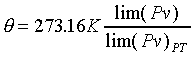
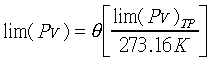
Chapter 5:理想氣體5-1 氣體狀態方程式:理想氣體溫標θ;定義是(定容溫度計) 理想氣體溫度定義是:
即
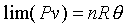
所以理想氣體常數即
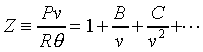
所以 定義:
可以用作圖法求得B和C;見圖5-2由v(Z-1)V.S.1/v作圖,則與Y軸之交點即為B,而斜率為C:
PS. 圖5-2之結果與表5-1相符合。 5-2 氣體的內能根據第一運動定律,在自由膨脹的過程中,Q和W都是零,所以系統的內能保持不變----但是系統的溫度是否有變化呢??即
在自由膨脹過程之中;dU=0;若dθ=0(即沒有溫度的變化)則
若在溫度不變的情形下,經由自由膨脹的過程;dU=0且dθ=0;則
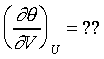
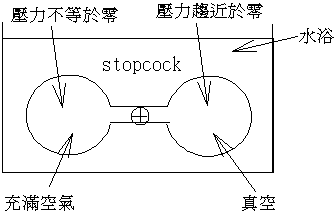
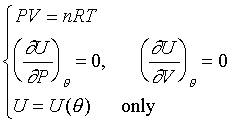
也就是說內能與壓力無關。由上述的討論可以知道;當進行自由脹時,若溫度沒有發生變化,則內能不是體積和壓力的函數而僅與溫度相關即U=U(θ)。為了要研究自由膨與溫度的關係Joule設計如下的實驗:
將開關打開以後,氣體自由膨脹到真空部份,測量膨脹前後的水溫,則可以知道Free
expansion與溫度的關係。但是水與容器的熱容量是氣體的一千倍左右,所以Joule無法測出任何溫度的變化,但事實上氣體的溫度會下降的。基本而言是失敗了。為什麼???→因為Cwater,C容器>>Cair
現代研究氣體內能的實驗(如下圖所示)是測量 發現
5-3 理想氣體
在0-2atm的範圍之內;真實的氣體可以被視為理想氣體誤差幾%而已。對靜流體系統:PV=nRT:
在定壓的情形下dP=0→dP/dθ=0 且
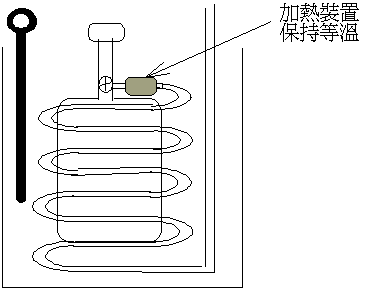
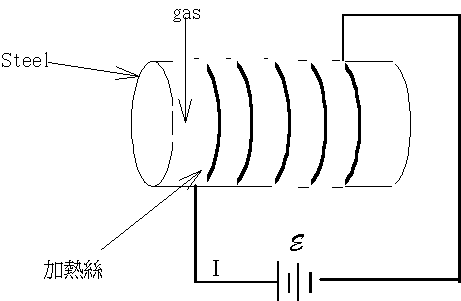
且 5-4 熱容量的實驗測量氣體的熱容量是利用電皂方法來測量,Cv的測量是將氣體置於一非常薄的鐵容器其體積保持一定,外繞加 熱用的電熱絲:
利用下等式 則可以求CV 其中 5-5 準靜的絕熱過程因為
且絕熱過程中
This equation holds at all equilibrium states through which an ideal gas passes during a quasi-static adiabatic process. 一系列的絕熱過程可以表示在PV相圖上,其斜率為
準靜的等溫過程也可以被一系列雙曲線表示,其斜率為
絕熱過程的斜率較大。 5-6 Ruchhardt's Method 測 g
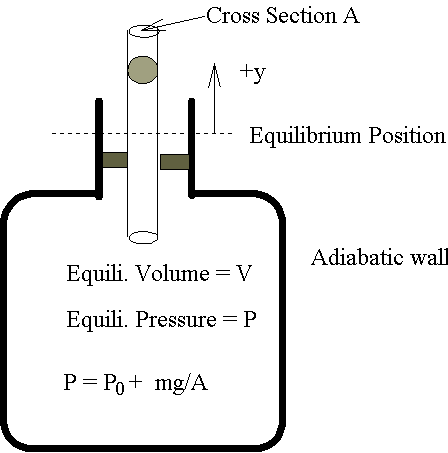
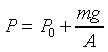
y 很小,當小球質量m,被下壓y後釋手,會產生簡諧運動。設週期為t,在不考慮摩擦力的情況下(P0 為大氣壓)
體積的變化dV=yA,而壓力的變化為
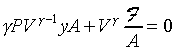
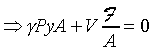
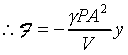
dP=F/A,其中F為合力之大小。因為振動快速,所以過程可以視為絕熱,且dV、dP均很小,故過程可以視為近平衡態。利用絕熱過程的條件得
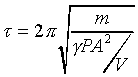
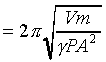
這是與虎克定律相似,故周期是
如此則可以求出g。利用這種方法量測的誤差來源有一)
氣體非理想氣體 二) 摩擦仍存在
三) The volume change is strictly adiabatic, but
it is not absolutely adiabatic. The modified Ruchhard's experiment to get more
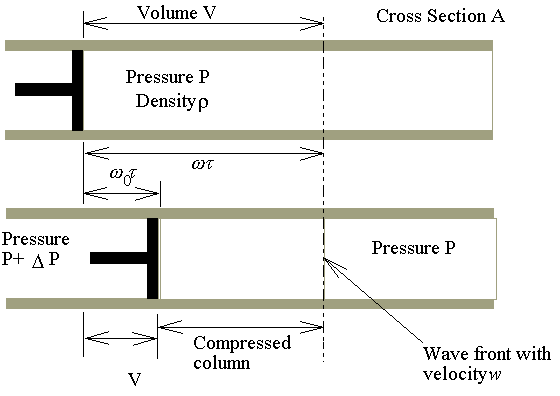
accurate data can be found in the text book. 5-7 Speed of a Longitudinal wave In this section we want to how g paly the role in the longitudinal wave. 當一物體(或系統)之某一部分被壓縮後,此壓縮的效應將會等速率,w,傳遞至其它部分,此速率的大小與組成物質的本質有關。下圖中,如果活塞被施力 P+DP 向右以等速度,w0,移動時,會產生壓縮(compression)以等速度w運動。當壓縮行進wt距離時,活塞移動w0t的距離。
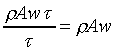
課本的說法:原來沒有壓縮區,活塞壓縮t時後,始有壓縮區的產生。故壓縮區的質量增加率為 且整個壓縮區介質的速度為w0,壓縮區動量隨時間的增加量(Dp/Dt)為
(考慮活塞被壓縮w0t),壓縮區動量隨時間的增加量(Dp/Dt)為
其中
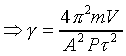
則壓縮區內壓力的改變DP為
或是壓縮區的速度是
此式首先由牛頓導出,式中含有一量
K為介質氣體之熱傳導係數。在溫差Dq之間的質量為
也就是說絕熱的條件是
In general, the typical wavelength is from a few
centimeters to several hundred centimeters. For gas at 0℃,
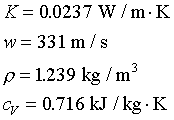
we have therefore
which is much smaller than the wavelength. In the case of metal, K would be larger, but this will be compensated by the much larger values of w and q, hence it will be still smaller than 155 nm. Therefore the adiabatic condition is fulfilled. The volume changes which take place under the influence of a longitudinal wave at ordinary frequencies are adiabatic, not isothermal. Let - as the adiabatic compressibility. So
For ideal gas
and
where M is the molar mass and v is the molar volume. Hence
For example, the speed of sound in are at 0℃
is about 331 m/s, M
for air is 28.96 kg/kmol, therefore g
is 1.40. The speed of sound wave in a gas can be measured roughly by means of
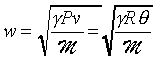
Kundt's tube. 5-8 Acoustical Thermometry(可以用來量測理想氣體溫) In previous section, we discuss the longitudinal wave in a tube. For more accurate measurement, the instrument equiped with an acoustic interferometer, one end of the tube is a source of waves such as a piezoelectric crystal and at the other a receiver. The distance of source and receiver is kept constant, the frequency of wave can be varied, the various resonances are reached. We can also use this equipment to determine the ideal gas temperature θ by plotting the square of the speed of sound as a function of pressure. Then
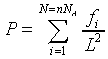
where 5-9 The Microscopic point of view 古典熱力學是建立在系統巨觀的行為上,用以描述系統的物理量也是巨觀的平均值。第一定律以能量守恒的法則,將熱、功和內能連繫在一起。當第一定律應用到同一種類的系統(如靜流體)所得之關係式對於此種類中的任一系統均成立,也就是說不考慮(或說無法考慮)各同類系統中微觀性質的差異。例如 經由碰撞而產生之單位面積單位時間內動量的改變是等於壓力。設壓力
因為
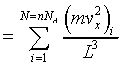
所以
而分子速度平方的平均值是
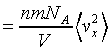
推演出
等於每個分子的平均動能,與實驗比較後得
所以每一個分子的平均動能等於(與能量均分定理結果相同)
k波茲曼常數,其值等於1.3805×10⁻²³ J/K。 註:另外一種解法是將系統考慮成正方體,則 The momentum change for the collision per molecule is
and the average per collision is
The force due to one collision is
thus the pressure on the suface is
This is the same result we have discussed above. |











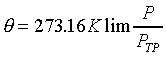
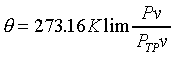
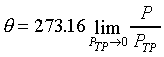 ,(當P和
,(當P和 趨近於零時)
θ與氣體的本質無關。但是當P和
趨近於零時)
θ與氣體的本質無關。但是當P和 不趨於零時,各種氣體所顯示的值都不同,表示與氣體本質有關(圖1-8)如果保持在定溫的氣體;測量其不同莫耳體積v及相對應之壓力P並求其乘積Pv,則Pv可以用Virial
Expansion的方法展開(為什麼???)(Pv可以視成密度的函數,當質量保持一定時,則可以視成1/v的函數,這就是為什麼要用Virial
Expansion。);即
不趨於零時,各種氣體所顯示的值都不同,表示與氣體本質有關(圖1-8)如果保持在定溫的氣體;測量其不同莫耳體積v及相對應之壓力P並求其乘積Pv,則Pv可以用Virial
Expansion的方法展開(為什麼???)(Pv可以視成密度的函數,當質量保持一定時,則可以視成1/v的函數,這就是為什麼要用Virial
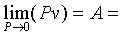
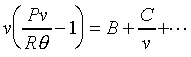
Expansion。);即 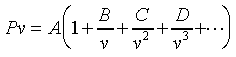 A、B、C等稱之為維里係數,例如A為第一維里係數,B為第二維里係數等。與氣體分子的特性有關。在0到40atm的壓力範圍之內,Pv和1/v實際上是有線性的關係。在此情況之上,祗有頭二個維里係數,A和B有重大意義。當壓力愈高所需考慮之維里係數就愈多。------為什麼。圖5-1中顯示固定溫度時,當P→零各種氣體之Pv乘積趨近一個定值;即
 溫度之函數與氣體無關
 (體積與莫耳數保持一定)
 -----→-------

 此系數稱之為Joule
Coefficient;這樣的效應稱之為Joule
effect。 一般而言:U=U(V,θ)或U=U(P,θ)
此系數稱之為Joule
Coefficient;這樣的效應稱之為Joule
effect。 一般而言:U=U(V,θ)或U=U(P,θ)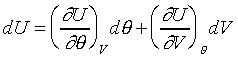
 ;換句話說即內能與體積無關。若用U=U(P,θ)來表示則: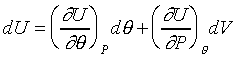

 的值;是利用一個既有作功又有熱傳導的等溫膨脹過程。圖5-3
 祗是溫度的函數與壓力無關


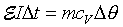 Δt為用電加熱時間,Δθ為在此時間內溫度的變化,m為氣體的質量,則cv
為相對應之定容比熱,
Δt為用電加熱時間,Δθ為在此時間內溫度的變化,m為氣體的質量,則cv
為相對應之定容比熱, CP的測量方法與CV類似;但氣體保持等壓力所以用氣體保持等壓力流過一熱量計,測知氣體通過後之溫差,氣體的流量則可以計算定壓熱容量;因為
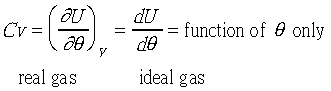
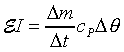 在低壓的情況下,實驗的結果與理想氣體相近,(定義cV和cP為莫耳熱容量)理想氣體有下例性質:(見課本第110頁)
1:cV is a function
of θ only 2:cP
is a function of θ only 3:cP-cV
= const. = R 4:γ=cP/cV
= a function of θ only and >1 低壓時的單原子氣體:如He,Ne和Ar及大多數金屬蒸氣如Na,Cd和Hg,在很大的一個溫度範圍有下例性質:
1:
在低壓的情況下,實驗的結果與理想氣體相近,(定義cV和cP為莫耳熱容量)理想氣體有下例性質:(見課本第110頁)
1:cV is a function
of θ only 2:cP
is a function of θ only 3:cP-cV
= const. = R 4:γ=cP/cV
= a function of θ only and >1 低壓時的單原子氣體:如He,Ne和Ar及大多數金屬蒸氣如Na,Cd和Hg,在很大的一個溫度範圍有下例性質:
1: 2:
2: 3:
3: 低壓的雙原子氣 體分子H2,D2,O2,N2,NO,CO等
1:
低壓的雙原子氣 體分子H2,D2,O2,N2,NO,CO等
1: ,在常溫時是常數,隨溫度增加而變大。
2:
,在常溫時是常數,隨溫度增加而變大。
2: ,在常溫時是常數,隨溫度增加而變大。
3:
,在常溫時是常數,隨溫度增加而變大。
3: ,在常溫時是常數,隨溫度增加而變小。對於多原子氣體分子,或是活性較大的氣體分子,如CO2,
NH3, CH4, Cl2, Br2 等,其Cv,
Cp和g隨溫度之變化而有所改變,且其變化隨氣體而各有不同。圖5-5是H2的隨溫度變化的測量,在低溫時
,在常溫時是常數,隨溫度增加而變小。對於多原子氣體分子,或是活性較大的氣體分子,如CO2,
NH3, CH4, Cl2, Br2 等,其Cv,
Cp和g隨溫度之變化而有所改變,且其變化隨氣體而各有不同。圖5-5是H2的隨溫度變化的測量,在低溫時 ,常溫時
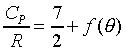
,常溫時 ,而高溫時為9/2。為什麼???因為低溫時移動效應明顯,而僅有三個自由度。常溫時是與我們所預測相同,多了兩個轉動自由度。高溫時振動的效應亦顯現。
這種變化,是可以用能量均分原理解釋的。(the
principle of the equipartition of energy)能量均分原理是指每一自由度供獻(1/2)nRq的內能。其餘的雙原子分子可以有寫成
,而高溫時為9/2。為什麼???因為低溫時移動效應明顯,而僅有三個自由度。常溫時是與我們所預測相同,多了兩個轉動自由度。高溫時振動的效應亦顯現。
這種變化,是可以用能量均分原理解釋的。(the
principle of the equipartition of energy)能量均分原理是指每一自由度供獻(1/2)nRq的內能。其餘的雙原子分子可以有寫成
 是等於或是
是等於或是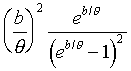 的組成。
的組成。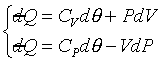 ,
, ,
所以
,
所以

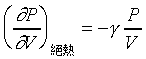
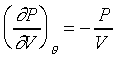 即
即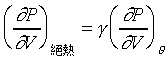 ,
,

 ,
,
 ,
,
 ,
, 。另一種看法是壓縮區質量增加的速率為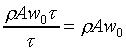
 ,跟據牛頓第二運動定律,可以有如下的式子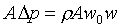
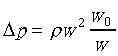
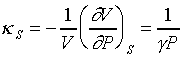
 與壓縮區體積改變的比例有關,所以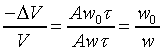
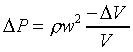
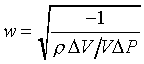
 ,牛頓認為是等溫壓縮係數(Isothermal
Compressibility),但實際上是絕熱壓縮係數。如果我們考慮兩個假想面,一在壓縮區的中心,另一在稀薄區中心,兩者之間的距離為
,牛頓認為是等溫壓縮係數(Isothermal
Compressibility),但實際上是絕熱壓縮係數。如果我們考慮兩個假想面,一在壓縮區的中心,另一在稀薄區中心,兩者之間的距離為 ,溫度差為Dq。當被壓縮波行進時,所傳導的熱量為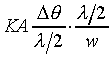

 ,而產生此溫差所需之熱為
 。如果壓縮波的傳遞是絕熱的,其條件是傳遞的熱太少而無法將其間質量為
 的介質產生Dq的溫差,即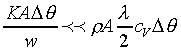


 = kS,
= kS,

 or
or

 is the extrapolation of the square of the speed of sound to zero pressure, which
assures ideal conditions.(見圖5-11)
is the extrapolation of the square of the speed of sound to zero pressure, which
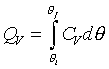
assures ideal conditions.(見圖5-11)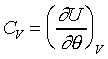 對所有靜流體系統中的固體、液體和氣體均成立。如果知道U和V、θ的關係,我們可以計算CV。在等體積過程中,如果知CV和θ的關係,熱量可以由下式算出:
 但是關於CV和U的關係的詳細關連,古典熱力學卻無法仔細的提供,而U
可以用微觀的方法計算而得。古典熱力學的另外一個極限是無法找出或理論導出狀態方程式。系統的狀態方程式,多半由實驗方法決定。考慮到系統微觀性質的理論有二:一是氣體動力論(Kinetic
Theory),另一是統計力學(Statistical
Mechanics)。此兩者以考慮分子運動為著眼,如碰撞,作用力,能量等。氣體動力論(Kinetic
Theory)可以處理下述非平衡的狀態:(由其是液態系統)
一) Effusion:分子由容器小孔滲透出來的過程。
二) Laminar Flow:Molecules
moving through a pipe under the action of a pressure difference. 三)
Viscosity:Molecules with momentum moving
across a plan and mixing with molecules of lesser momentum. 四)
Heat Conduction:Molecules with kinetic
energy moving across a plan and mixing with molecules of lesser energy. 五)
Diffusion:Molecules of one sort moving
across a plane and mixing with molecules of another sort. 六)
Chemical Kinetics:兩種或多種化學分子的有限速率的化學結合
七) Brownian Motion:
統計力學由分子能量的觀點出發,對於平衡系統可以解釋的很好,但對於非平衡系統體系仍有相當大的空間需要去了解。
5-10 Kinetic Theory--Equation of state of an ideal
gas 用簡單的氣體動力論求理想氣體的狀態方程式。其基本假設有
一)任何一系統所包含的粒子數,N,均非常大,且外觀都相同無法區別。例如理想氣體在一大氣壓下0℃時體積為2.24×104cm3,但有6.0225×10²³個粒子。體積為
1 cm3,有3×10¹⁹個粒子。體積為
1 mm3,有3×10¹⁶個粒子。體積為
1 mm3,有3×10⁷個粒子。二)
理想氣體分子由小而硬的球所組成,且為隨機運動。分子的體積可以被忽略,或說分子之間的距離較分子的大小大許多。三)
理想氣體分子間沒有任何的作用力,如吸引力、排斥力等。
四)
理想氣體分子間的碰撞均為彈性碰撞,與壁的碰撞亦為彈性碰撞。五)
理想氣體分子處於無外力作用的情況下時,分部是均勻的。
六) 理想氣體分子運動速度方向沒有特定的取向。(也就是各方向運動的粒子數是一樣多。七)
理想氣體分子運動速度是一分佈,每一分子的運動速度都不同。
速度方向沒有特定的取向,考慮一任意的速度向量w,如圖5-12所示,由原點到面積dA',此面積所對應之立體角為
但是關於CV和U的關係的詳細關連,古典熱力學卻無法仔細的提供,而U
可以用微觀的方法計算而得。古典熱力學的另外一個極限是無法找出或理論導出狀態方程式。系統的狀態方程式,多半由實驗方法決定。考慮到系統微觀性質的理論有二:一是氣體動力論(Kinetic
Theory),另一是統計力學(Statistical
Mechanics)。此兩者以考慮分子運動為著眼,如碰撞,作用力,能量等。氣體動力論(Kinetic
Theory)可以處理下述非平衡的狀態:(由其是液態系統)
一) Effusion:分子由容器小孔滲透出來的過程。
二) Laminar Flow:Molecules
moving through a pipe under the action of a pressure difference. 三)
Viscosity:Molecules with momentum moving
across a plan and mixing with molecules of lesser momentum. 四)
Heat Conduction:Molecules with kinetic
energy moving across a plan and mixing with molecules of lesser energy. 五)
Diffusion:Molecules of one sort moving
across a plane and mixing with molecules of another sort. 六)
Chemical Kinetics:兩種或多種化學分子的有限速率的化學結合
七) Brownian Motion:
統計力學由分子能量的觀點出發,對於平衡系統可以解釋的很好,但對於非平衡系統體系仍有相當大的空間需要去了解。
5-10 Kinetic Theory--Equation of state of an ideal
gas 用簡單的氣體動力論求理想氣體的狀態方程式。其基本假設有
一)任何一系統所包含的粒子數,N,均非常大,且外觀都相同無法區別。例如理想氣體在一大氣壓下0℃時體積為2.24×104cm3,但有6.0225×10²³個粒子。體積為
1 cm3,有3×10¹⁹個粒子。體積為
1 mm3,有3×10¹⁶個粒子。體積為
1 mm3,有3×10⁷個粒子。二)
理想氣體分子由小而硬的球所組成,且為隨機運動。分子的體積可以被忽略,或說分子之間的距離較分子的大小大許多。三)
理想氣體分子間沒有任何的作用力,如吸引力、排斥力等。
四)
理想氣體分子間的碰撞均為彈性碰撞,與壁的碰撞亦為彈性碰撞。五)
理想氣體分子處於無外力作用的情況下時,分部是均勻的。
六) 理想氣體分子運動速度方向沒有特定的取向。(也就是各方向運動的粒子數是一樣多。七)
理想氣體分子運動速度是一分佈,每一分子的運動速度都不同。
速度方向沒有特定的取向,考慮一任意的速度向量w,如圖5-12所示,由原點到面積dA',此面積所對應之立體角為
 (最大立體角的度量為4p)設
 是速度介於w到w
+ dw之間的總粒子數,而速度介於w到w
+ dw之間且方向是朝著立體角
是速度介於w到w
+ dw之間的總粒子數,而速度介於w到w
+ dw之間且方向是朝著立體角 的粒子數,
的粒子數, ,為
,為
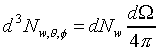 上式也說明理想氣體分子運動速度方向沒有特定的取向。考慮一圓柱型的體積dV,如圖5-13所示,
 。若設V是總體積,則只有在圓柱型中分子佔所有總分子數的比例為
 ,則
Number of w, θ,
f molecules
striking dA in time dt =
,則
Number of w, θ,
f molecules
striking dA in time dt =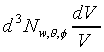 上式表示理想氣體分子分佈是均勻的。另一假設是所有的碰撞都是彈性碰撞,則以θ入射而經dA反彈的分子其動量的改變為
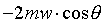 ,因為只有垂直分量有變化。故以θ入射而經dA反彈之所有理想氣體分子所造成總動量的改變為
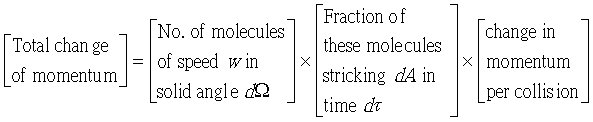


 為牆施給由各個方向的
 個氣體分子的壓力。則改變動量改變的正負號,可以得到各個方向都有的
 氣體分子施給牆的壓力
 ,即
,即

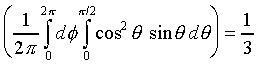 ,
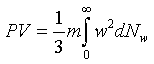
,
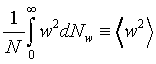 ,
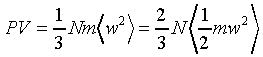
,

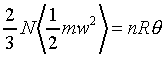
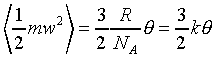

 。
。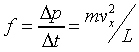 ,
,